BS Zelda, or BS Zelda no Densetsu, is a Super Famicom Zelda that Nintendo R&D2 developed and St.GIGA published for Japan's Satellaview, starting on August 6, 1995. It existed only while a satellite was sending it. Each of its four weekly episodes could be downloaded during one hour on a Sunday evening. The voices came down with the game and were gone when you switched the console off. That voice acting could not be preserved. What anyone plays today, of this game or of its 1997 sequel, Ancient Stone Tablets, is a fan rebuild.
Nintendo-sponsored students built it on the first game's map
BS Zelda came out of student networking projects that Nintendo sponsored to make a game for the satellite network. The goal was to connect players "from Kyushu to Hokkaido". The students found it hard. Nintendo's quality control was strict: the game had to run with no lag and no bugs. It went through at least two beta versions before release. Shigeru Miyamoto and Takashi Tezuka are listed as the designers.
Real multiplayer never happened: only one character could be on screen at a time. Everyone played in the same hour instead.
BS Zelda adapts the first Zelda without being a sequel to it. The first game's overworld was 8 by 16 screens. Each episode showed an 8-by-8 piece of it. The room layout of the eight dungeons spells "St.GIGA", the publisher's name. The dungeons of the December 1995 remix, MAP2, spell "NiNtENDO." The two sets are known as the Third Quest and the Fourth Quest.
BS Zelda aired on four Sundays of August 1995
Episode 1 aired on Sunday, August 6, 1995, from 6 p.m. to 7 p.m., and episodes 2 to 4 followed on August 13, 20 and 27. The game had been announced in early July on a SoundLink magazine show, Hikaru Ijuin's Natsuyasumi no Ō-sama.
The hour was called Zelda Time, and the name covered the clock inside the game too. That clock showed real time.
Miss an episode and you waited. Reruns ran in September, October and November 1995, then again on January 1 to 4, 1997. MAP2, with new dungeons, started on December 30, 1995. Ocarina of Time never lets Link pick up the Triforce. Here, collecting all eight pieces earned a "secret membership card" for the Nichibutsu Casino. Fifty top scorers, picked by lottery, won 8-megabit memory packs.
SoundLink streamed three voices into RAM, then lost them
BS Zelda was the first SoundLink game, meaning the satellite carried sound along with the data. Kiyoshi Kobayashi narrated and played the Old Man, Naomi Fujisawa voiced Princess Zelda, and Seizo Kato voiced Ganon.
The voice files were too big for the Satellaview's 8 Mb ROM, so the game held them in RAM and overwrote them as you went. When the narrator spoke, the 1995 game paused with a "Listen closely" message.
Collectors dumped game data from 8-megabit memory packs that had not been overwritten. The voices left nothing to dump.
Ancient Stone Tablets added a 1997 thunderstorm that disabled bombs
Ancient Stone Tablets began airing on March 30, 1997, again in four weekly episodes, and was the last SoundLink game broadcast on the Satellaview. It is set six years after A Link to the Past and is sometimes regarded as an enhanced remake of it. The cast grew to five voice actors, with Hiroshi Isobe as narrator and Mariko Koda as Zelda. Reruns followed in June 1997, late 1998 and May 1999.
The events ran on the clock. About 20 minutes into the first episode a thunderstorm hit, and bombs stopped working until the rain cleared ten minutes later. The sequel also loosened the controls. Players could keep walking during voice messages, and the Pegasus Boots let you change direction while running.
You played your own BS-X avatar, and the mole moved between reruns
Link does not star in either game. You were the character you made in the BS-X menu, and the name and gender you picked carried into the game. In 1997 the story says outright that Link has left the country, and your avatar, the Hero of Light, goes after the tablets.
The 1997 game kept score. Players lost 500 points a minute until both stone tablets were found, and finding the mole was worth 10,000. Talking to the mole opened a grotto with hundreds of rupees. The five top scorers each week won 8-megabit memory packs, with scores sent in as passwords.
The mole's spot changed from one rerun to the next. A rerun can be dated by its content.
Fans rebuilt both games from memory pack dumps and VHS tapes
For Ancient Stone Tablets, fans filled the gaps in the dumps with VHS recordings of the original broadcast. A full English fan translation appeared online in fall 2016. The four-week version is rebuilt as four ROMs, and some alternate versions may be lost for good.
For the 1995 game, patches remove the download pauses and time limits, merge the episodes into one, and add a title screen and file select. Some swap the avatar for Link, and some MSU-1 projects add fan-made voice acting of the original script. The words survived even where the recordings did not: the translator Glitterberri published an English version of the SoundLink script.
MottZilla's patch keeps the broadcast shape. Its beta 0.95 is dated May 6, 2012. It joins both maps in one ROM. A playthrough always takes 200 minutes: four weeks of 50. The English translation is by Duke Serkol and Bumpus. The patch runs on a real Super Nintendo.
Questions people ask
What is BS Zelda?
It is a Zelda game that Nintendo R&D2 made for the Satellaview in 1995. "BS" is short for broadcast satellite. It aired as four weekly episodes in August 1995 and was rerun several times.
Is Ancient Stone Tablets a sequel to BS Zelda?
It is the follow-up on the same service, not a continuation of the 1995 story. Ancient Stone Tablets has a new plot set after A Link to the Past and a new cast of five voice actors. It aired from March 30, 1997.
What was the Satellaview?
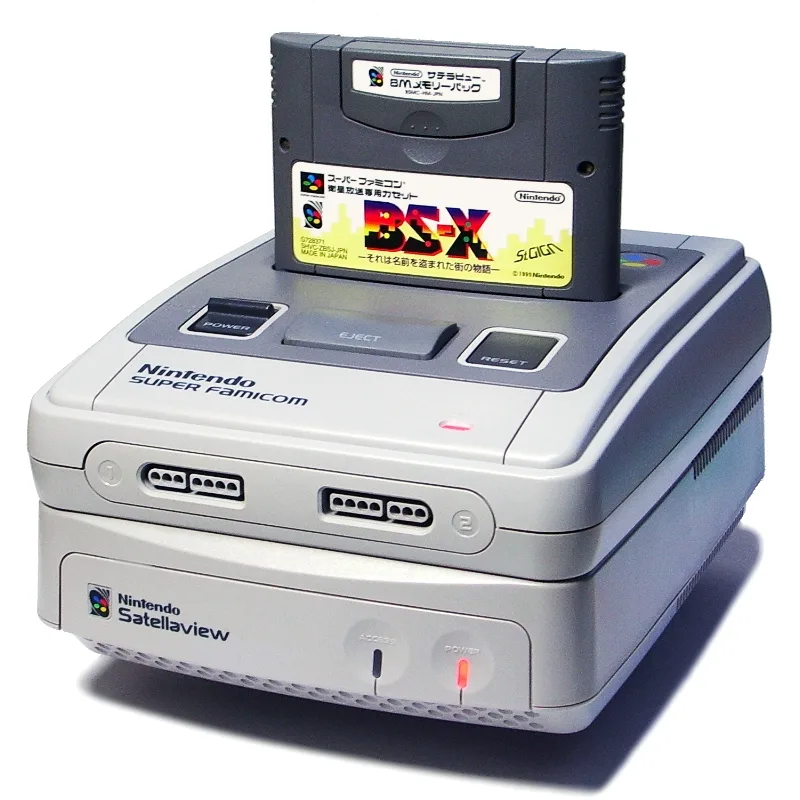
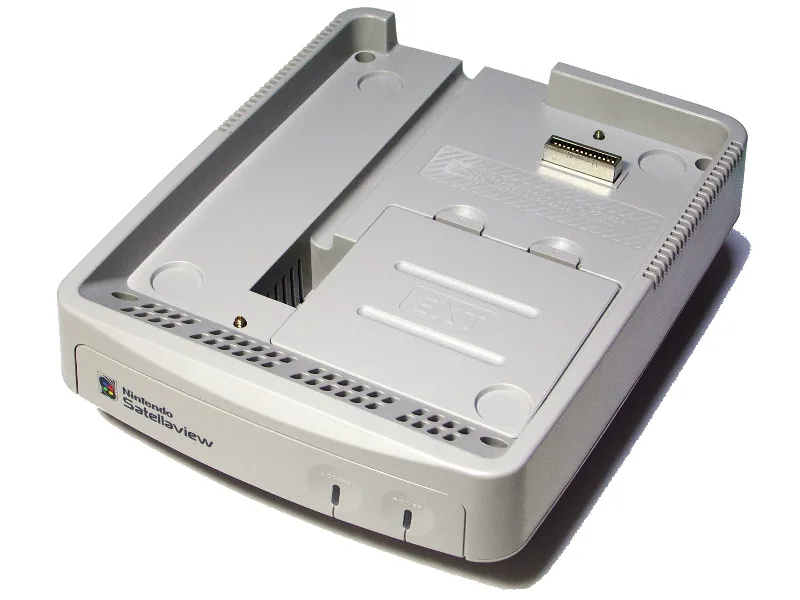
It was a satellite modem for the Super Famicom, sold only in Japan. Broadcasts began on April 1, 1995, and the device went on sale on April 23 for ¥14,000. It plugged into the console's expansion port and needed a satellite dish. The BS-X cartridge served as its menu, and St.GIGA ran the broadcasts.
Can you still play BS Zelda?
Not as it aired. Zelda Universe says there is no way to play them today in their 1990s form, and the voices were never saved. What fans play is a patched rebuild from memory pack dumps, on an emulator or, with MottZilla's patch, on a real Super Nintendo.
Sources
- Satellaview games from The Legend of Zelda series (Wikipedia)en.wikipedia.org
- BS Zelda no Densetsu (Wikipédia)fr.wikipedia.org
- Satellaview (Wikipedia)en.wikipedia.org
- The lost Zelda game people never got to play (SVG)svg.com
- BS Zelda Real Hardware patch by MottZillabszelda.zeldalegends.net
- A forgotten chapter: The Satellaview Zelda games (Zelda Universe, 2020)zeldauniverse.net