Creatures, a 1996 game designed by Steve Grand at Millennium Interactive in Cambridge, has pet aliens called Norns. Each one hatches with a genome whose genes can mutate. It thinks with a small neural network that learns from what happens to it. Grand and Dave Cliff wrote that design up in a 1998 paper that other researchers have cited more than 70 times.
The game came out in November 1996 in Europe and in July 1997 in North America, for Windows and Macintosh. Warner Interactive published it in Europe and Mindscape in North America; the Stanford course page names Millennium Interactive and Warner Brothers Interactive as the 1996 publishers.
Steve Grand built Creatures at Millennium Interactive in Cambridge
The project started as a desktop pet with a brain, an idea Grand described in a 1992 note called "Mouse for Windows." It grew into a self-contained world called Albia. Development took four years, CyberLife said in an October 1996 press release.
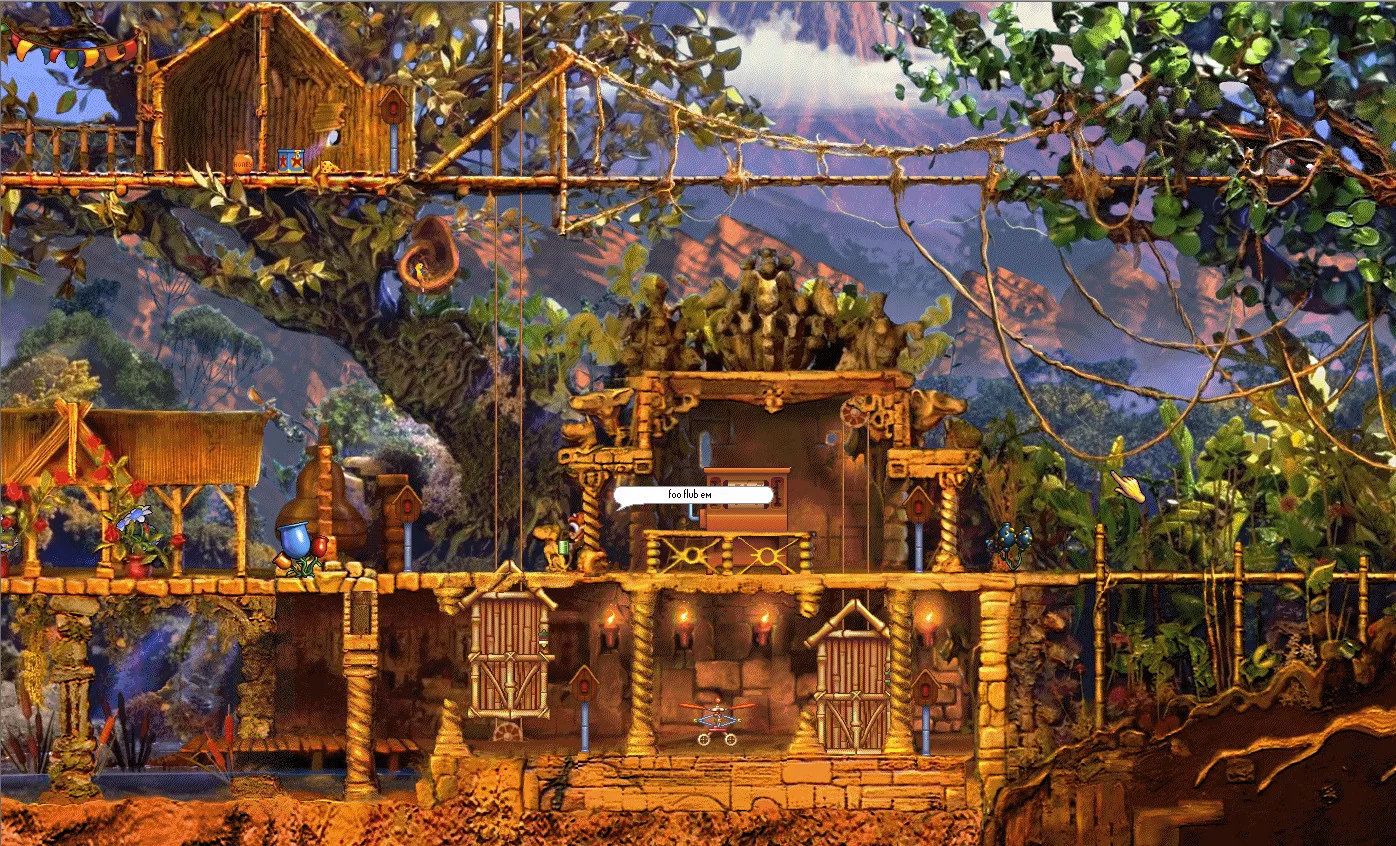
Albia is a photograph of a real model. The team struggled with 3D graphics and animation, so Grand suggested building the world by hand and digitizing it. The Centre for Computing History says the model was made from materials including wood and wire. It was shot with a long lens to cut distortion, then scanned and stitched together. That model is one of three parts and is now at the museum, which believes the other two are with members of the team.
Grand later said the marketing people told him to hide the science. "'People aren't interested in science,' they said," he told MIT Technology Review, and added: "They were wrong." The magazine describes the Norns as big-eared, bug-eyed bipeds that looked like a cross between an Ewok and a Furby. Players taught them to survive and explore, and could teach them words by naming objects. Left alone, the Norns still reproduced and evolved.
Every copy of the game shipped with its own starting set of eggs, Next Generation reported in November 1996. Mindscape's John Moore told GameSpot in 1997 that the company expected to sell more than 200,000 copies by the end of the year. GameSpot counted 100,000 copies sold by November 1997. Worldwide sales neared 400,000 by February 1998.
Millennium renamed itself CyberLife Technology in 1996. On July 15, 1997, Sony Computer Entertainment's London studio announced it would buy CyberLife's game development arm. The deal included the rights to future games such as MediEvil. The remaining company was renamed Creature Labs and ceased operations in 2003. Gameware Development then bought the development and trademark rights.
Each Norn hatches with one copy of every gene
Human cells carry two copies of most genes, and one copy can mask the other. Norns are haploid. Each has one version of every gene, so inheritance has no dominant or recessive pattern. That removes most of the dangers of inbreeding.
Genes can mutate and produce behaviors the designers never thought of. The genome sets chemical reactions and half-lives, and a mutation in those can make a Norn immortal.
Mutations come in two classes. Point mutations change one value inside a gene. Duplications copy whole sections of genetic code, and omissions delete them. Mutations are more often beneficial in the games than in real life. The critical brain lobes are shielded from mutation. Without that shield, more eggs would be stillborn.
"Almost immediately, people devised Norn Genome Projects, breeding experiments and adoption agencies," Grand told MIT Technology Review.
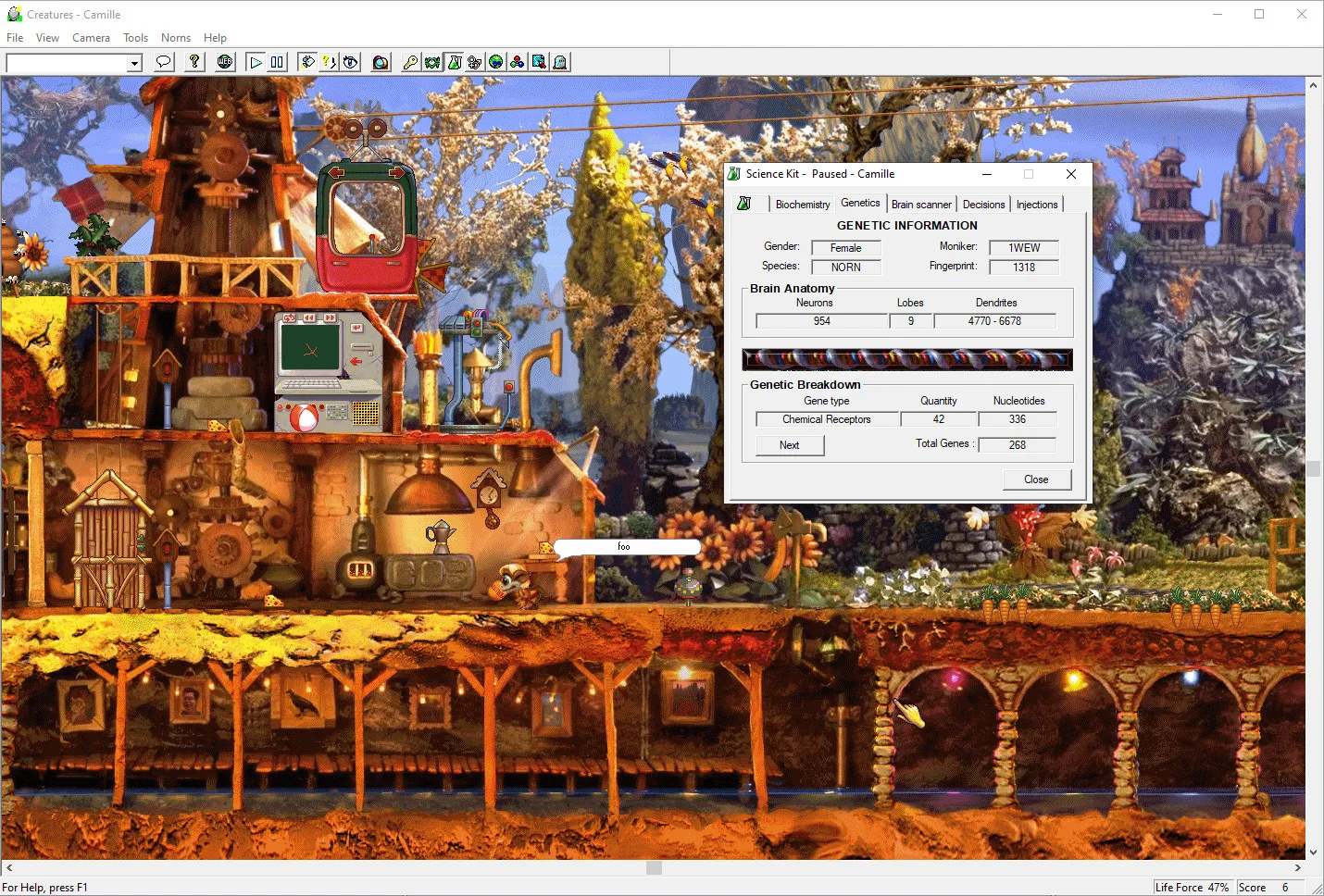
A 952-neuron brain does the learning
Alan Zucconi's breakdown of the game's AI puts a first-generation Norn at 952 neurons and about 5,000 connections, grouped into nine lobes. The Attention lobe has 40 neurons, one per class of object, and the strongest one decides what the Norn is looking at. The Decision lobe has one neuron per action, and the highest value wins. A lobe could only connect to two others, so Drive, Verb, General Sense and Attention all feed a Perception lobe. Perception then feeds the Concept lobe, where one neuron stands for a whole situation, such as "I am hungry and food is near me."
Wiring every neuron to every other would take over a million connections. "Out of those one million potential connections, Creatures could only afford 5000," he writes. Keeping only the connections that matter gives the Norn a sparse picture of its world. He calls that as close as you could get with an Intel Pentium in 1996. A player talks to a Norn by typing verbs such as "push," which switch on the matching neurons.

Norns learn while they sleep
The connections start out random, and the Norn has to find out which ones to keep. Reward and punishment signals come from 19 instincts written into first-generation Norns. Eleven of them reward a Norn for doing what the player asked. The game processes those instincts while the Norn sleeps. Connections that paid off get stronger through reinforcement, and harmful ones weaken through atrophy. Weak connections are detached and moved elsewhere, a step called migration.
The 1998 paper has been cited more than 70 times
Grand and Dave Cliff wrote "Creatures: Entertainment Software Agents with Artificial Life." It appeared in March 1998 in Autonomous Agents and Multi-Agent Systems, volume 1, issue 1, pages 39 to 57. Semantic Scholar counted 74 citations as of October 21, 2026.
MIT Technology Review says the game inspired many people to pursue careers in artificial intelligence. According to The Hollywood Reporter, Charlie Brooker drew on it for Thronglets, a fictional game in the 2025 Black Mirror episode "Plaything."
Creatures 1996 is playable today through The Albian Years
The Steam page lists the original inside Creatures: The Albian Years, a compilation of Creatures and Creatures 2 with their Life Kits and Object Packs. Gameware Europe announced the Steam release in a November 25, 2021 press release and said it would arrive later that December. On October 21, 2026, it cost €5.99 on Steam, where 27 of its 30 reviews were positive. GOG announced in November 2009 that it was selling the bundle.
Questions people ask
Is Creatures on Steam?
Yes, as part of Creatures: The Albian Years, which bundles the 1996 game with Creatures 2. It is on Steam, and on GOG, which has sold it since 2009.
Does Creatures run on Windows 10 or 11?
The 2021 release announcement says the games were updated for modern operating systems with historic bugs fixed. The Steam page still lists Windows 95 to XP requirements.
Is Creatures 2 included, and how does it differ?
Yes, the bundle holds both games. Creatures 2 came out in North America on August 28, 1998, and shipped about 200,000 copies at release. The Creatures Wiki says its creatures have around 800 genes. About half shape behavior and appearance. The rest run the biochemistry and the nervous system.
What platforms was the Creatures PC game on?
Windows and Macintosh at launch, then PlayStation and Game Boy Advance. The Steam version lists Windows only.
Get the game.
Sources
- Creatures (1996 video game) - Wikipedia (citing GameSpot 1997 and 1998, Next Generation No. 23, the CyberLife EMMA Award release of October 1996, IGN 2002, Jeuxvideo.com 2001 and 2002, The Hollywood Reporter 2025)en.wikipedia.org
- Creatures (video game series) - Wikipedia (citing Steve Grand, Mouse for Windows, Cyberlife Research 1992; Gameware Development archive)en.wikipedia.org
- Creatures 2 - Wikipedia (citing CNET Gamecenter, August 28, 1998; Cliff and Grand, Artificial Life 5(1), 1999)en.wikipedia.org
- Guerrilla Cambridge - Wikipedia (citing GameSpot, Sony Buys Cyberlife, July 16, 1997; GameSpy company profiles for Cyberlife Technology and Millennium Interactive)en.wikipedia.org
- Creatures - Development Model - Centre for Computing Historycomputinghistory.org.uk
- Creatures - Stanford STS 129 Artificial Lifeweb.stanford.edu
- A Grand Quest to Create Virtual Life - MIT Technology Reviewtechnologyreview.com
- Haploid - Creatures Wikicreatures.wiki
- Genetics - Creatures Wikicreatures.wiki
- Mutation - Creatures Wikicreatures.wiki
- The AI of Creatures - Alan Zucconialanzucconi.com
- Creatures: Entertainment Software Agents with Artificial Life, Grand and Cliff, Autonomous Agents and Multi-Agent Systems 1(1), March 1998 (Springer, DOI)doi.org
- Creatures: Entertainment Software Agents with Artificial Life, Semantic Scholar (citation count)semanticscholar.org
- CREATURES released on Steam - Gameware Europe via Cambridge Network, November 25, 2021cambridgenetwork.co.uk
- Creatures: The Albian Years - Steamstore.steampowered.com
- Creatures: The Albian Years - GOGgog.com