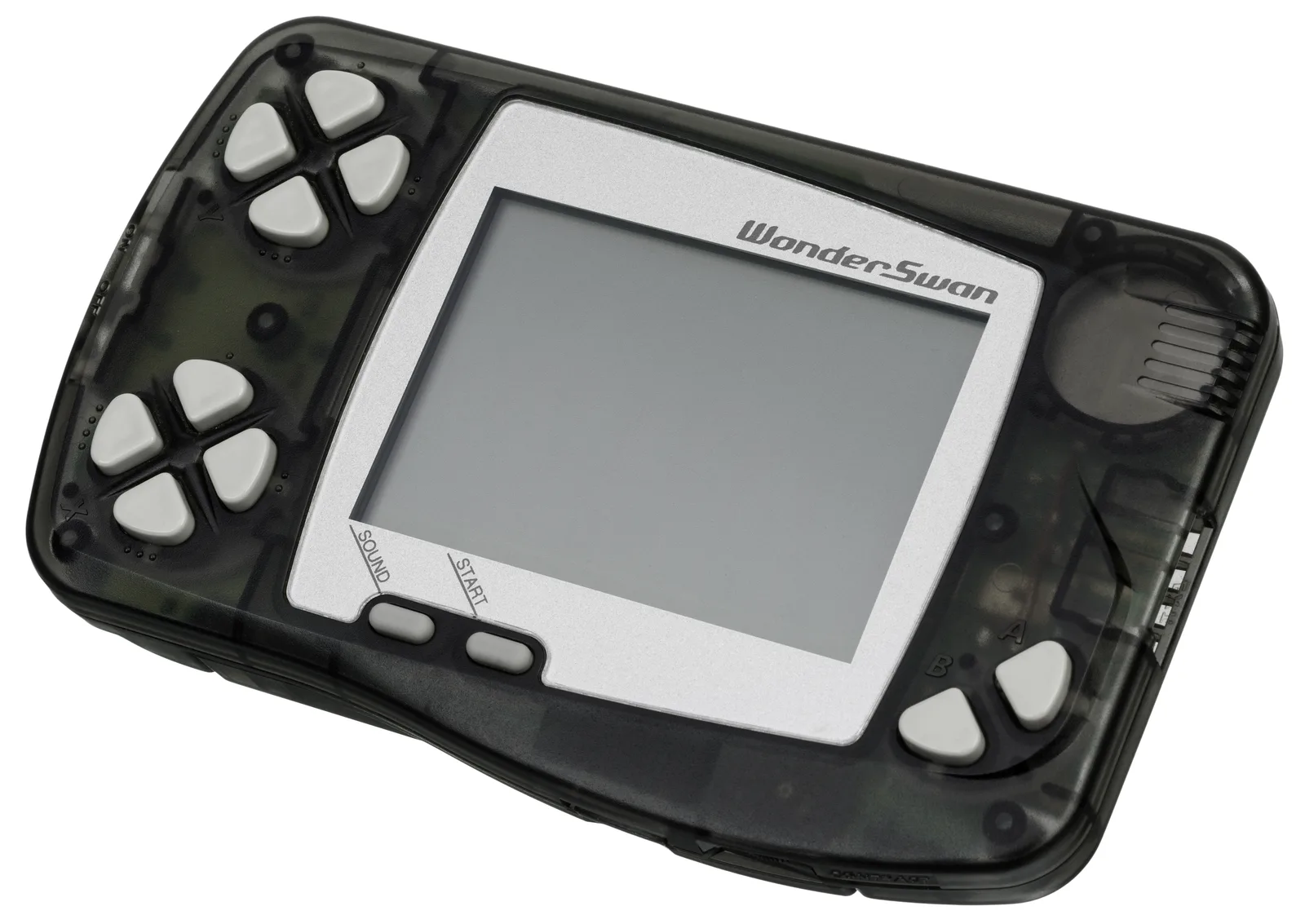
The WonderSwan is a handheld console that Bandai released in Japan on March 4, 1999. Koto Laboratory, the firm of Game Boy creator Gunpei Yokoi, did the engineering. Yokoi died in 1997, before the last console he designed went on sale. Bandai sold it only in Japan. Three models came out between 1999 and 2002. The family outsold the Neo Geo Pocket, the rival that did go West.
How Yokoi and Bandai built it
Yokoi left Nintendo on August 15, 1996, after 31 years. Nintendo called the timing "absolutely coincidental" to the Virtual Boy's weak sales. A colleague said he had long planned to retire at 50. He then co-founded Koto, a Kyoto product development firm staffed with former Nintendo subordinates, and Koto led the engineering of Bandai's new handheld.
The design followed Yokoi's own rule, which he called "Lateral Thinking with Withered Technology." He wanted cheap, mature technology that could be mass-produced instead of the newest parts. The WonderSwan has a 16-bit NEC V30 MZ processor at 3.072 MHz, 64 KB of RAM and a 224 by 144 screen. It launched at ¥4,800, about $31 at the time.
On October 4, 1997, Yokoi was a passenger in a car driven by a business associate, Etsuo Kiso, on the Hokuriku Expressway. The car rear-ended a truck. Both men got out to look at the damage, and a passing car driven by Gen Tsushima hit Yokoi. He was pronounced dead about two hours later, at 56. The console reached stores seventeen months after that.
His name is in the launch lineup. Gunpey, a puzzle game named in tribute to him, was developed by Koto and came out on launch day, March 4, 1999, next to Bandai's Digimon Adventure: Anode Tamer.
The screen that turns sideways
You can hold the WonderSwan upright or sideways. The buttons are arranged as eight on the left in a double diamond and two on the right. One set of four is the D-pad in each orientation. Upright, it suits shooters. Sideways, it plays like an ordinary handheld.
The original had a monochrome screen. It ran about 40 hours on one AA battery. Later models gave up battery life for the screen.
Bandai also opened the hardware to hobbyists. WonderWitch, an official development kit from Qute Corporation, sold for ¥11,800 and let amateurs write WonderSwan programs in C.
WonderSwan Color and SwanCrystal
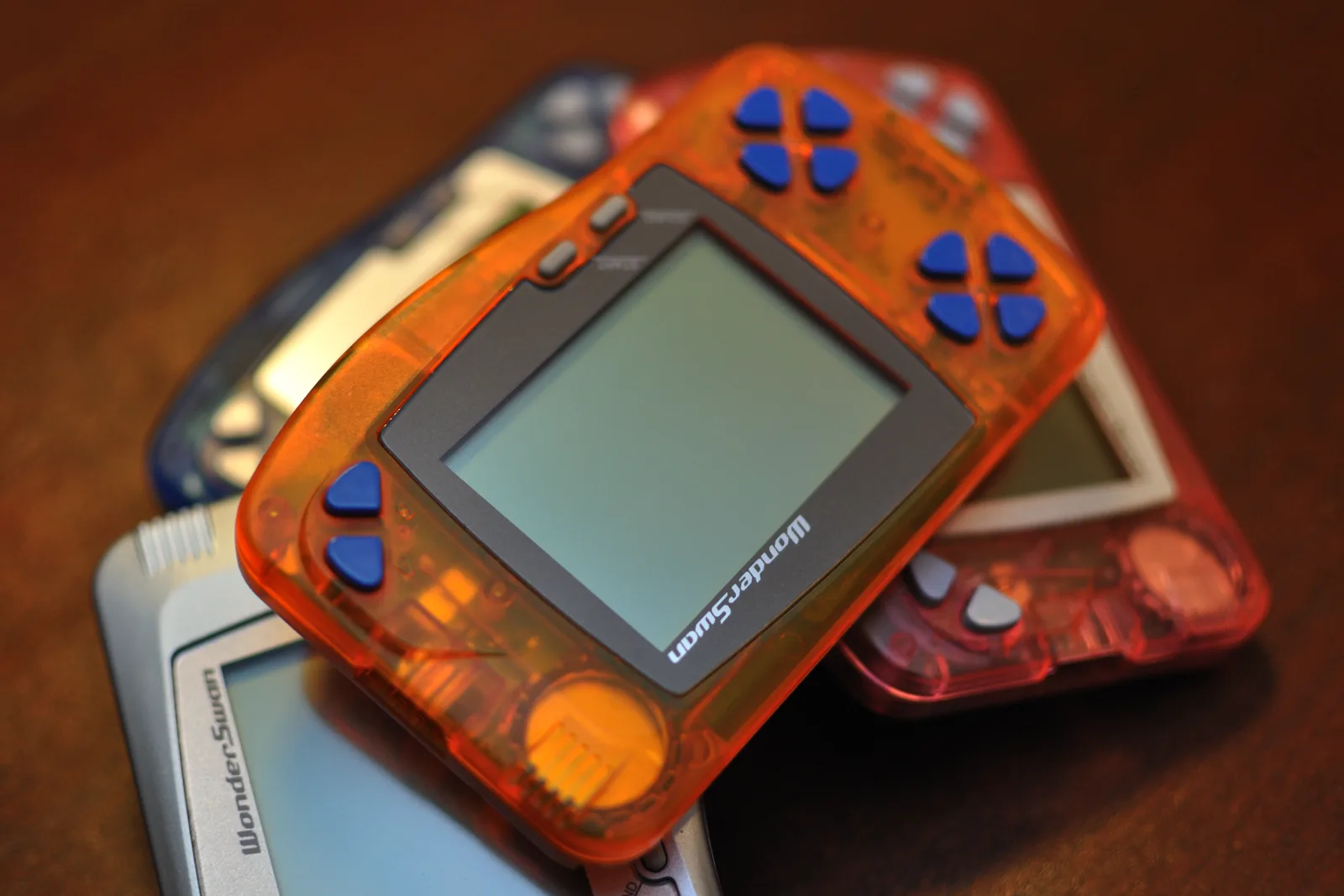
Bandai kept the line going with two revisions, both Japan-only. The WonderSwan Color arrived on December 9, 2000 at ¥6,800 with a color screen and backward compatibility with the older cartridges. It sold 270,632 units in under a month and was rated for 20 hours on a battery. The SwanCrystal followed on July 12, 2002 at ¥7,800. It has a TFT screen and a more durable case. Its battery is rated for 15 hours.
The color models show 241 colors at once from a palette of 4,096, and the SwanCrystal's screen has less ghosting than the Color's. The SwanCrystal came out when the Game Boy Advance was already on sale. Nokia's N-Gage went on sale in 2003 against the same Game Boy Advance. Bandai discontinued the line in 2003 for low demand and backed out of video game hardware altogether.
Across the three models about 3.5 million units sold: roughly 1.55 million originals, at least 1.1 million Colors and about 850,000 SwanCrystals. Its share of the Japanese handheld market peaked at 8%, though Time Extension puts it at nearly 10 percent. Koto claims that 10 million cartridges were sold.
Square, Digimon and about 200 games
Square had fallen out with Nintendo during the Nintendo 64 era and shifted its allegiance to Sony. It then backed the WonderSwan with new titles and ports of Final Fantasy and Front Mission. The remakes came out on the Color: Final Fantasy on its launch day, December 9, 2000, Final Fantasy II on May 2, 2001 and Final Fantasy IV on March 29, 2002. A Final Fantasy III remake sits on the canceled list. Time Extension calls the Final Fantasy IV port the best version of that game at its release. Square later brought all three remakes to the Game Boy Advance.
Bandai published its own Digimon games. The original WonderSwan got three Digimon Adventure games, starting with Anode Tamer at launch. The Color got eight more games with Digimon in the title, including Digimon Tamers: Brave Tamer on December 29, 2001. Bandai also released exclusive Gundam titles, and Taito brought Space Invaders and Densha de Go!. Racketboy names Judgement Silversword as the system's best shooter, and also recommends Klonoa: Moonlight Museum and Guilty Gear Petit 2.
Playing a WonderSwan today
Most of the library is in Japanese, and the games with little text are the easiest to play. Racketboy lists several emulators that run most games: Mednafen, higan, OSwan and WSCamp. The MiSTer FPGA also has a WonderSwan core.
On real hardware, Racketboy points to flash cartridges such as the FlashMasta, which load games from a computer over micro USB, though stock is scarce. The same guide puts a bare original at about $25 to $55, a bare Color at $40 to $85 and a bare SwanCrystal at $88 to $150. Most games sell for under $10 to $20.
Questions people ask
Did the WonderSwan release in America?
No. All three models stayed in Japan. Bandai signed a deal with Mattel in 2000 to bring it to North America, then dropped the plan. The reason is unknown.
What other Japanese handhelds competed with the WonderSwan?
Nintendo's Game Boy line and SNK's Neo Geo Pocket. The Neo Geo Pocket launched around the same time and was sold in North America and Europe, but it sold an estimated two million against the WonderSwan family's 3.5 million.
Can you play WonderSwan games in English?
Not officially, since nothing was released outside Japan. Fans fill the gap with patches. The Chocobo's Dungeon port got an English patch in May 2020, and Clock Tower's WonderSwan version got one in August 2025. The Final Fantasy IV patch is unfinished but translates the menus.
How many games were released for the WonderSwan?
About 200. The original has 109 games and the Color has 91 of its own, and the Color plays the black-and-white cartridges too.
What is the difference between the WonderSwan Color and the SwanCrystal?
Both play the same color games. The SwanCrystal has a TFT screen with less ghosting and a more durable case, but a 15-hour battery rating against the Color's 20.
Sources
- WonderSwan - Wikipediaen.wikipedia.org
- Gunpei Yokoi - Wikipediaen.wikipedia.org
- List of WonderSwan games - Wikipediaen.wikipedia.org
- List of WonderSwan Color games - Wikipediaen.wikipedia.org
- Bandai WonderSwan 101: A Beginner's Guide - Racketboyracketboy.com
- Best WonderSwan Games Of All Time - Time Extensiontimeextension.com
- Anniversary: Game Boy Creator Gunpei Yokoi's WonderSwan Is 25 Years Old - Time Extensiontimeextension.com
- Clock Tower's WonderSwan Port Gets English Fan Translation - Time Extensiontimeextension.com
- Chocobo's Dungeon for WonderSwan - Siliconerasiliconera.com