Seaman is a virtual pet game developed by Vivarium and published by Sega for the Dreamcast. It came out in Japan on July 29, 1999 and in North America on August 8, 2000. You raise a fish with a human face by talking to it through a microphone, and it answers back with insults. The face is modeled on its designer. Leonard Nimoy narrates the English version.
Seaman started as a joke about a fish tank
Designer Yoot Saito got the idea for Seaman as a joke while a coworker was building a tropical fish simulator. His wife found the early sketches gross, and she backed the idea anyway. Saito knew from the start what the creature should not be: "it wouldn't be cute, it would look into the gamer's world from inside the TV".
The prototype ran on a Macintosh. Saito told Vice that building it there turned out "too costly." The team moved to the Sega hardware that became the Dreamcast and wrote nearly everything from scratch. Turning the prototype into a console game took roughly a year and a half. Jellyvision is credited as a developer too.
Sega wanted a celebrity to voice the creature in Japan. Saito did the voice himself. He called that "the key to success." The voices of the younger forms stayed in the office too. Saito's daughter voiced the baby Seaman, and a programmer's daughter voiced the young one.

The fix for bad speech recognition was to blame the player
Testers talked to the fish in long sentences, and late 1990s speech recognition could not follow them. After the first prototype's voice recognition failed, some developers began to doubt the project. The first fallback line was "Can you say that again?" Saito changed it to "You talk too long, I don't understand", and players learned to answer in short phrases. Saito summed up the trick: "We disciplined the user instead of changing the software." I still think that is good product design. The insult covers for a parser that could not follow long sentences.
The creature changes shape in five stages
The game runs in real time, and you have to check on the creature at least once every real day or it can die. The life cycle has five stages. The Mushroomer is a parasite that overruns the nautilus that eats it. It becomes a Gillman, then a Podfish. At the Podfish stage the aquarium turns into a terrarium. The Tadman is the next generation. The Frogman is the last form. You release it into the wild and keep it moist with a sprinkler.
Early on you feed it and keep the tank clean. Later the game turns into conversation. The creature remembers what you tell it and uses it against you. It says "You're not very good at this, are you?" when you make mistakes and "Why are you feeding me this garbage?" when the food is bad. Ask it about getting a girlfriend and it replies, "It might have something to do with your face."
It also shares trivia: give it your birthday and it recounts significant events from that date. None of this happens fast. The game unfolds over days or weeks of real time.
Leonard Nimoy narrated the English version
Nimoy did not voice the fish. He provided the narration in the English version, as a calm, scientific observer. The Japanese narrator was Toshiyuki Hosokawa, and Saito voiced the creature.
Sega of America spent nine months on the English localization. Dialogue about sex and politics was rewritten, as was the Japanese slang. The Japanese game commented on your memory card save data. That feature was removed from the English version over privacy concerns.
The manual adds a fake backstory about a French biologist, Dr. Jean-Paul Gassé, who studied the creature's eggs from Alexandria in 1932. A website, meetseaman.com, expanded it between 2000 and 2004.
How to play Seaman today
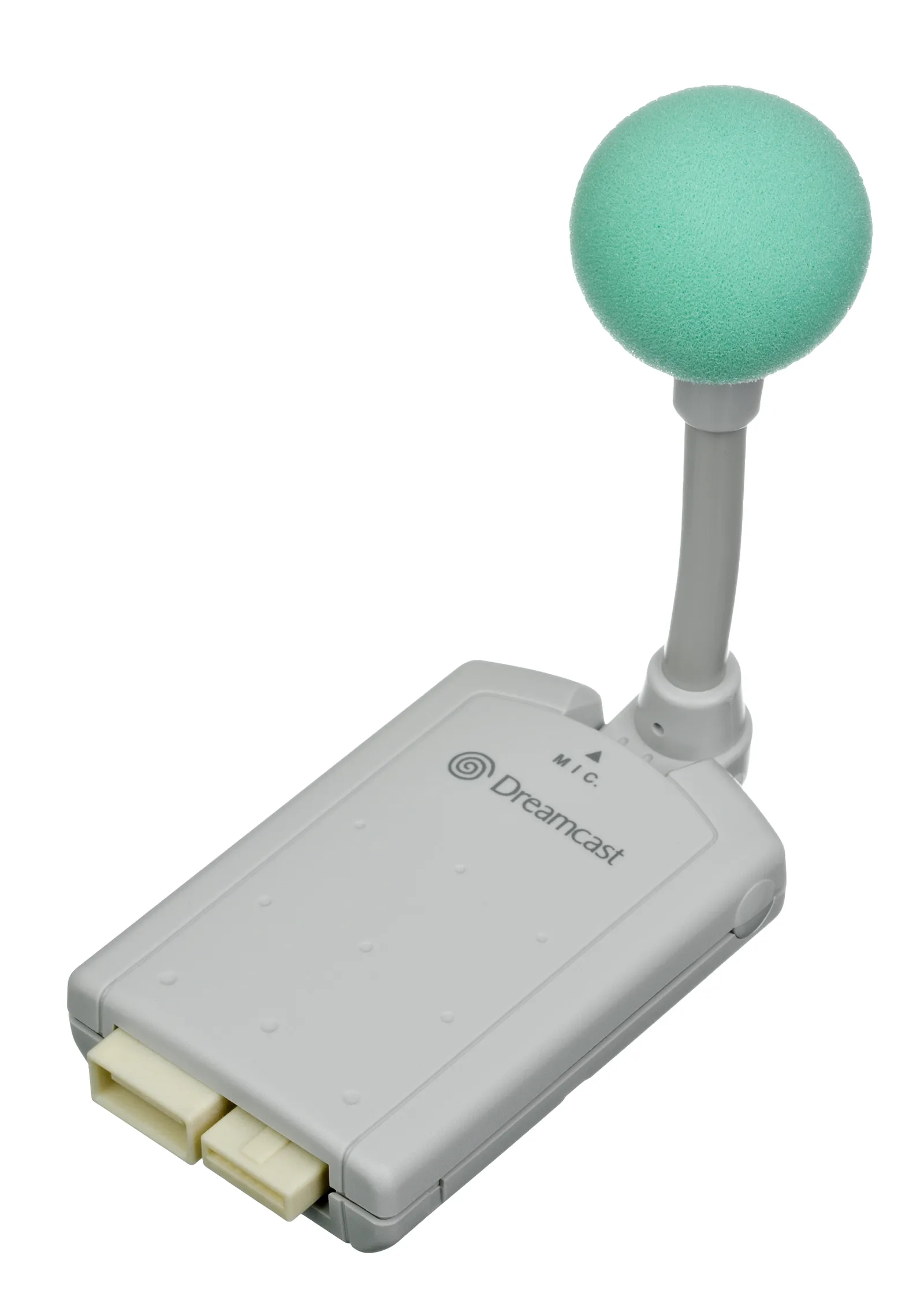
You need a Dreamcast and the microphone. The North American game was only sold at retail in a bundle with the microphone. On PriceCharting, checked October 23, 2026, the North American game sits at $42.50 loose and $71.57 complete. Each sells about once a week. A sealed copy goes for $209.99.
The Japanese release is the cheaper one. A loose Japanese copy is at $16.50, a complete copy at $59.99, and a sealed copy at $483.75 on the same date. A Japanese disc needs a console that reads Japanese discs. The fish speaks Japanese too.
The PlayStation 2 version came out in Japan only, on November 15, 2001. Its first edition included a microphone.
Sales, reviews and the sequels
The Dreamcast version sold 399,342 copies in Japan as of February 2004, the third best seller on the platform there. The PS2 version added 305,632 in Japan by November 2008. Metacritic has the game at 82 out of 100, IGN gave it 8.3 and GameSpot 6.6. In 2000 Planet Dreamcast called it "the single most original title to ever appear on the Dreamcast." GameSpot wrote, "You'll either find Seaman fascinating or incredibly boring."
It won an Excellence Award for Interactive Art at the 1999 Japan Media Arts Festival and Original Game Character of the Year at GDC 2002. Game Informer put it on a list of the weirdest games of all time in 2008.
Sega squeezed a few side projects out of the fish. Christmas Seaman was a two-disc digital greeting card sold in Japan from December 16 to 26, 1999, one disc for sending messages and one for receiving them. A Windows version was canceled, and a cut-down version called SeaMail, where Seaman interacted with your email, came out in 2003 instead.
Seaman 2 came out for the PS2 in Japan in 2007, and a Nintendo 3DS game was canceled. Later Saito posted a teaser image with a link to Seaman.ai, a site that read "Under Construction". No release has been announced.
Questions people ask
Why did Sega stop making consoles?
Sega announced on January 31, 2001 that the Dreamcast would end after March 31, 2001, and that Sega would become a third-party developer. Sega sold about 3 million Dreamcasts in the United States against a target of roughly 5 million, and price cuts and rebates added to its losses.
What does Dreamcast mean?
Sega picked the name from more than 5,000 entries. It blends "dream" and "broadcast".
How does the Seaman game work?
You talk to the creature through the Dreamcast microphone and it replies, mostly by asking questions that want short answers. You also feed it and tend its tank, and it grows through five stages. A single check-in each day is the minimum to keep it alive.
What were the launch games for the Dreamcast?
The North American launch on September 9, 1999 had 19 games, led by Sonic Adventure and Soulcalibur. Seaman was not among them. It reached North America 11 months later.
Is Seaman on PS2?
Only in Japan. The PS2 version came out on November 15, 2001 with a microphone in the first edition, and it stayed in Japan.
Is there a Seaman 2?
Yes, for the PS2, in Japan only, in 2007.
Sources
- Seaman (video game) - Wikipediaen.wikipedia.org
- The cursed AI Dreamcast game that talks back - Mike Berger Gamesmikebergergames.substack.com
- Seaman: The Weird History of SEGA's Strangest Game - Gardiner Bryantgardinerbryant.com
- Yoot Saito on his classic Sega game where you take abuse from a fish - Vice (Adam Jackson, 2015)vice.com
- Seaman Prices Sega Dreamcast - PriceChartingpricecharting.com
- Seaman Prices JP Sega Dreamcast - PriceChartingpricecharting.com
- Seaman creator teases virtual pet reboot - bit-techbit-tech.net
- Dreamcast - Wikipediaen.wikipedia.org