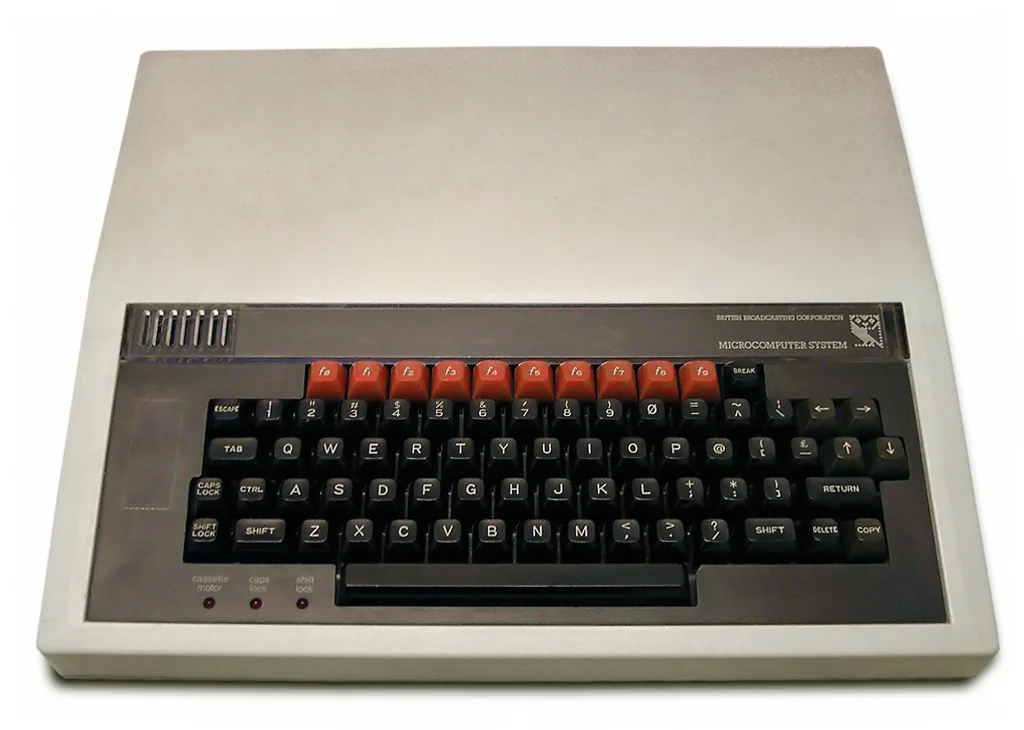
Elite came out for the BBC Micro on September 20, 1984, written by the Cambridge students David Braben and Ian Bell and published by Acornsoft. It is a space trading and combat game with eight galaxies of 256 planets each. None of those planets is stored anywhere in the program. The machine works each one out from a seed number every time you look at it. Thirty years later, Braben's studio Frontier released Elite Dangerous on the same idea. Its galaxy is too big to store any other way.
Two students, one rejection and a £1,000 advance
Braben and Bell met at Jesus College, Cambridge. Bell was working on a game called Freefall for Acornsoft, and Braben had started one called Fighter. After comparing notes, and after seeing Star Raiders on the Atari 800, they decided to build one game together.
They first pitched it to Thorn EMI, which turned it down as "too complicated" and said a game should be finishable in ten minutes with three lives. Acornsoft's managing director David Johnson-Davies liked the combat and docking demo. The deal was a £1,000 advance and a 7.5% royalty. The company worried that two authors on one title was a risk.
The work took two years. At first the two worked apart, in the summer holidays. Bell told The Register, "There wasn't any email; we used to send each other five and a quarter inch floppy disks by post." Later they worked in each other's rooms at college. The game began as a 3D arcade shooter with no trade at all.
The 3D radar was the last feature added, and it went into the last few unused bytes of memory. Acornsoft spent £50,000 on promotion, including TV advertising and a launch party at Thorpe Park. The box came with Robert Holdstock's novella The Dark Wheel alongside the flight manual. The BBC Micro version sold 107,898 copies, and Bell puts the total across all platforms near 600,000.

How a seed number builds eight galaxies
The program holds a short seed. Run it through a fixed algorithm and it produces a planet's position, name, government, economy and prices. Text is assembled from a lookup table. No planet data is stored in memory.
The finished code takes 21,906 bytes of main memory, leaving 66 bytes free in the whole machine. The BBC version splits the display between two graphics modes, a sharp monochrome Mode 4 for the space view on top and a four-color Mode 5 for the dashboard below.
The galaxy count was a business decision. "Originally the galaxy count started at one and just kept going up," Bell told The Register. Johnson-Davies asked for eight, and Bell later agreed that a hundred galaxies would have made it obvious the data could not be stored. The pair also removed a whole galaxy after finding a planet with a rude name in it.
The generator has other odd results. Some planets sit beyond the seven light year fuel allowance. Bell said extra fuel tanks would have fixed that, if memory had allowed.
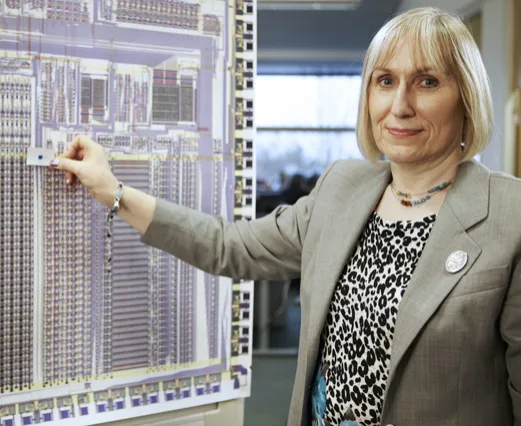
Sophie Wilson, who designed the BBC Micro, called Elite "the game that couldn't have been written".
Guinness calls it the first procedural world
Guinness World Records lists Elite under first use of procedural generation in a videogame. The same entry gives Frontier: Elite II the first procedurally generated star systems and Frontier: First Encounters the first generated terrain and textures.
Elite won the Golden Joystick for Best Original Game of 1984. Crash gave the ZX Spectrum version 92%. In 2008 Next Generation ranked it the best game of the 1980s.
The ports went out under Firebird, starting with the ZX Spectrum in 1985. The Commodore 64 conversion added Trumbles, small creatures that breed in your cargo hold, and plays "The Blue Danube" when you switch on the docking computer. On the Acorn Electron the game ran in black and white. It had no Thargoid enemies and no suns.
From Elite to Elite Dangerous
The series has five main entries. Elite Plus arrived for MS-DOS in 1991, and Frontier: Elite II followed in 1993. Frontier: First Encounters came out in 1995. Elite Dangerous was conceived in 1998 as "Elite 4" and funded through Kickstarter in late 2012. It was released on December 16, 2014.
Elite Dangerous has a galaxy of billions of stars, where the 1984 original has 2,048 planets. By 2024 it had sold more than three million copies.
How to play the original Elite today
Mark Moxon's site hosts fully commented 6502 assembly source for the BBC Micro, Acorn Electron, Commodore 64, NES and other versions, and a guide to playing them. Its page on the original cassette version links to the BBC Micro Elite Compendium, which runs in a browser, and to a downloadable disc image for an emulator or real hardware.
Frontier has given the game away on its own store more than once. In 2019, for the 35th anniversary, it offered a free copy of Elite (1984) for PC and Mac. For the 40th in 2024 its announcement said the original was "available FREE in the Frontier Store". The browser version on Moxon's site is free.
Questions people ask
What language was Elite written in?
6502 assembly language. Braben and Bell wrote it as machine code with great care for compactness, and Moxon's site documents the original listing as 6502 code.
Can you still play the original Elite?
Yes, for free. The BBC Micro version runs in a browser through the Elite Compendium linked from Moxon's site, or in an emulator with a disc image from the same place. Frontier also offered it as a free download in 2024.
What ships are in Elite 1984?
You fly a Cobra Mark III, starting as Commander Jameson at Lave Station with 100 credits. Most of the other ships are named after snakes, the Adder and the Anaconda among them.
What platforms was Elite released on?
The BBC Micro and Acorn Electron first, then many ports: the ZX Spectrum, Commodore 64, Amstrad CPC, MSX, Apple II, Atari ST, Amiga and the NES in Europe. A Sega Mega Drive version was canceled.
How big is Elite from 1984?
The BBC Micro code is 21,906 bytes, with 66 bytes free in the whole machine. That is about 22 KB.
Is Elite Dangerous the same game as the 1984 Elite?
No. Elite Dangerous is the series' fifth game, released in December 2014 and funded on Kickstarter two years earlier.
Get the game.
Sources
- Elite (video game) - Wikipediaen.wikipedia.org
- Elite (video game series) - Wikipediaen.wikipedia.org
- The Register: Elite, the game that couldn't be written (January 2024)theregister.com
- First use of procedural generation in a videogame - Guinness World Recordsguinnessworldrecords.com
- Elite on the 6502 - Mark Moxonelite.bbcelite.com
- Information on the original version of Elite - Mark Moxonelite.bbcelite.com
- Elite series celebrates 35th anniversary with freebies - WorthPlayingworthplaying.com
- Celebrate Elite's Ruby Anniversary - Frontier post via devtrackers.gg (2024)devtrackers.gg