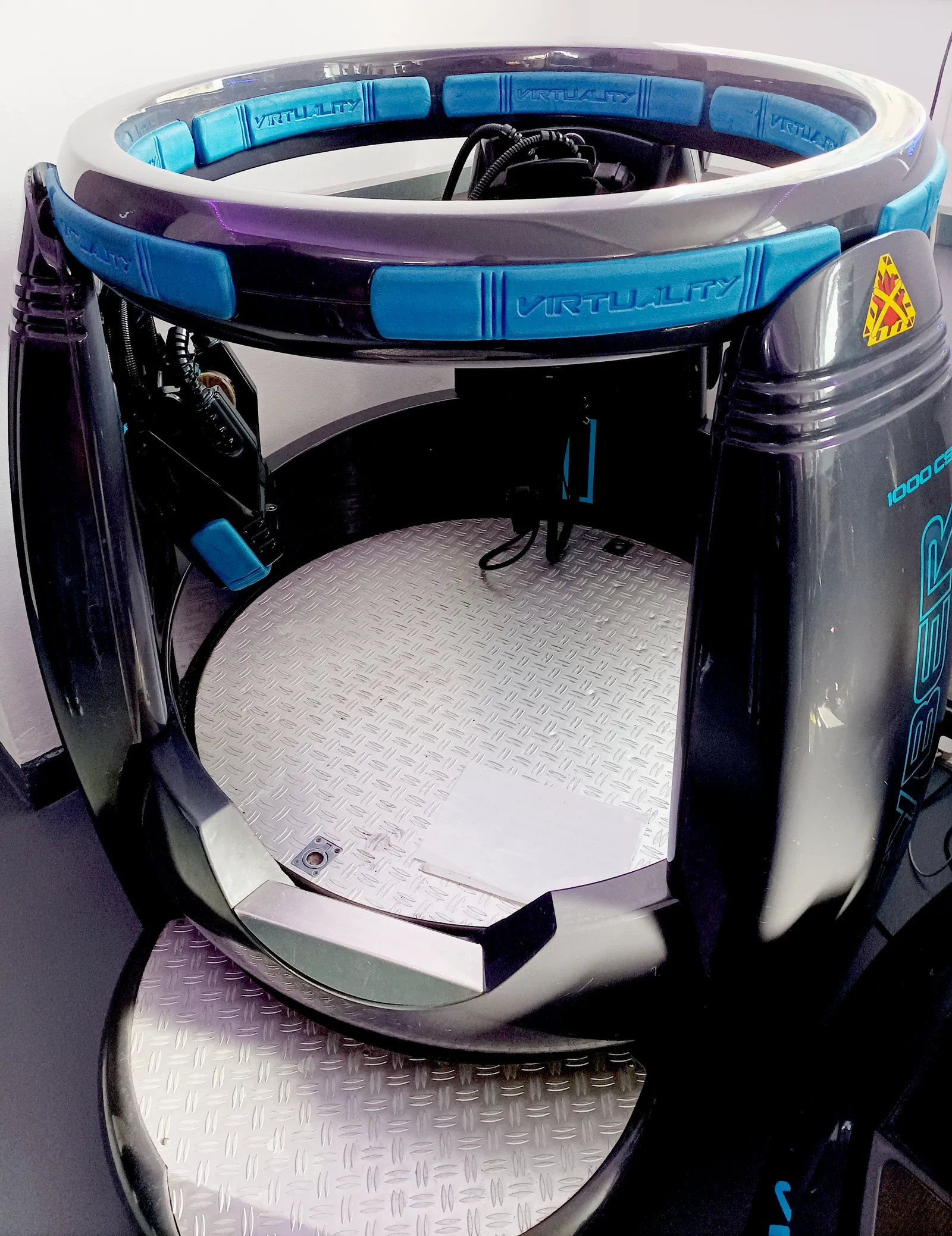
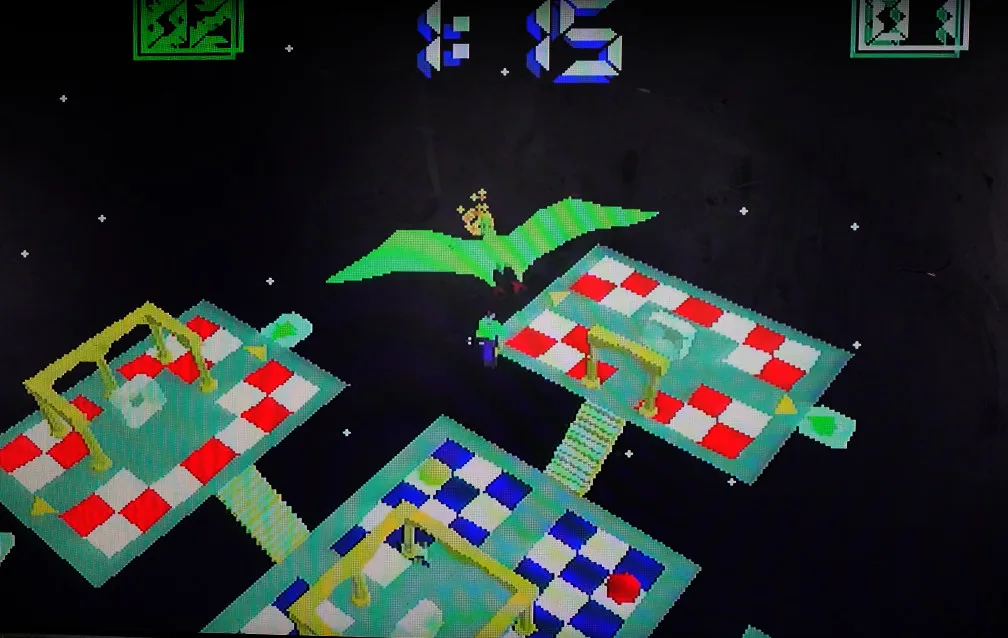
Dactyl Nightmare is a 1991 arcade game for the Virtuality 1000CS, a stand-up VR pod from the Leicester company W Industries, which renamed itself Virtuality in 1993. Up to four players stood in rings on the arcade floor with headsets on, shooting at each other across floating platforms while a pterodactyl swooped down to pick up unwary players. The machine underneath was an Amiga 3000 with extra graphics boards. Kotaku put its chips at about the speed of the original PlayStation.
W Industries grew out of a Leicester PhD project
The company was founded in October 1987 around Dr. Jonathan Waldern, whose earlier research at Leicester Polytechnic had produced a stereoscopic system by 1986. Waldern formed the company with Al Humrich, Richard Holmes and Terry Rowley. Their prototypes included the "giraffe," a headset hung on a mechanical boom arm. A fifth prototype, built by 1989, became the basis of the first product.
That product, the 1000 series, debuted at Computer Graphics '90 in London and came in two versions, a stand-up unit and a seated one. The arcade version of the stand-up, the 1000CS, followed in 1991. The first networked systems did not go to an arcade: British Telecom's research labs bought the first two.
Don McIntyre, who worked at the company, called the 1000 series "essentially an Amiga 3000 with our own proprietary cards based on a Texas Instruments chipset." It had 4 MB of fast RAM and two TMS34020 graphics accelerators, one for each eye. They drew 30,000 polygons a second at 20 frames per second. Matt Wilkinson, a former Rare developer, called the early Dactyl Nightmare a "terrible" game but an "incredible" experience. Looking back, he called VR "a gimmick that the company desperately tried to shoehorn a gaming experience onto."
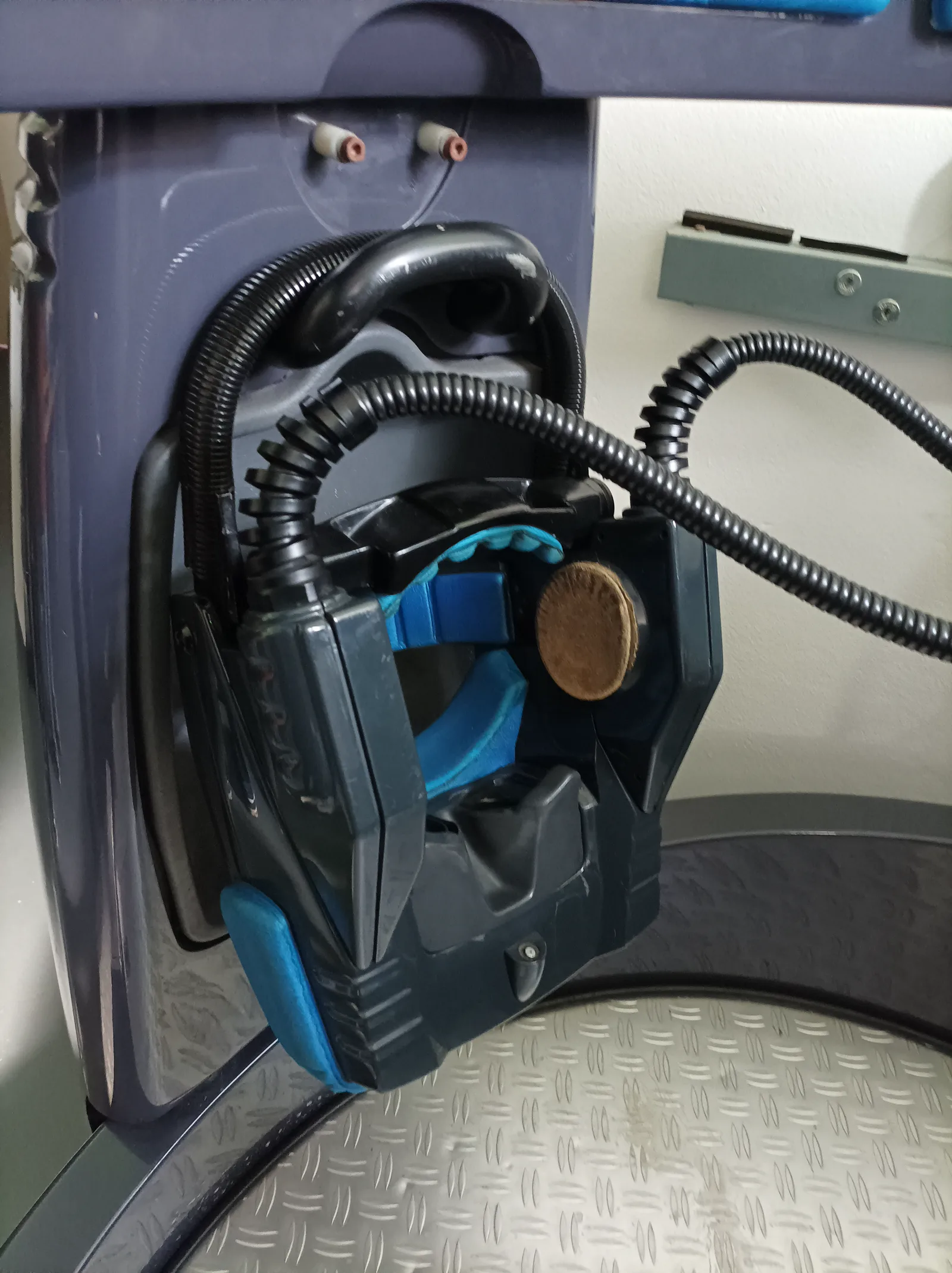
Wilkinson described lag and magnetic sensors that jittered when the tracker moved too far from the field generator. The two LCD lenses sat on motors so each player could set the distance between them, and each display had its own focus control because there was no room for glasses inside the headset. Designers also found that players often stood staring at a wall.
For a Tomorrow's World segment in November 1990, the machines crashed under the studio lights and would not boot. The footage that aired was pre-recorded, and the people in the pods on screen were wearing headsets that were switched off.
A Dactyl Nightmare session was five platforms and a slow gun
You stepped into a waist-height ring. It held the tracking unit for a Polhemus Fastrack magnetic tracker, which followed your head in six degrees of freedom. The headset, called the Visette, had LCD screens at 372 by 250 pixels per eye, plus speakers and a microphone. In your hand was a space joystick with two buttons, one to fire and one to move.
Dactyl Nightmare was first-person deathmatch with a capture-the-flag mode. Players were drawn as polygons and their shots reacted to gravity. An advanced mode added axes, shields and crossbows. The game was originally called just "Nightmare," and it launched alongside Grid Busters, Hero and Legend Quest on the 1000CS.
The arena had five floating platforms, and the gun fired once every two seconds. Fall off and you dropped into a digital void. A visitor to a Virtuality exhibit in Australia stepped off the platform into "an inky digital abyss." Her session ended soon after. Everything was flat-shaded polygons.
The pod cost tens of thousands and a go cost £4
Arcade History lists the 1000CS as a stand-alone unit retailing for $60,000. Kotaku quotes a different figure, about £30,000 to manufacture, with each game adding £5,000 to £10,000 and the tracking system alone about £6,000.
Players paid around £4 for three minutes, when a normal coin-op cost 50p. Simon Marston, now a volunteer at Leicester's Retro Computer Museum, paid £2 a go at Thomas' Arcade in Leicester in 1992 and spent about £10 most Fridays. Each arcade also needed staff to help people into the headsets.
Why the pods disappeared
Only 350 1000CS units were built, 120 of them installed in the US, and production ended in 1994. A 1994 sequel, Dactyl Nightmare 2: Race for the Eggs, ran on the 2000 series, which added texture mapping and swapped the Amiga for a 33 MHz 486 PC. Reviewers had already named the weak points. Computer Gaming World said in 1992 that the main complaints were the lack of resolution and software support.
The company kept selling its know-how to bigger names. It partnered with Sega on the VR-1 attraction in 1994, and Atari commissioned a Jaguar VR headset that reached the prototype stage in 1995 and was never released. Arcade sales declined with the wider trend, and Virtuality's own home VR efforts were not successful. It entered bankruptcy in 1997, when about 1,200 machines were in use. The assets went to Cybermind Interactive Europe, then to Arcadian VR in 2004 and to VirtuosityTech in 2012. Waldern founded the optics company DigiLens in 2004.
Where to play it today
The surviving pods are kept alive by collectors. Marston bought a 1000CS on eBay in 2013, not fully working, and after a few months of repairs took it to a retro event where more than 100 people queued to play. In 2016 he told Kotaku he believed his two restored stand-up pods were the only working ones left, and that his fix for faults was "basically... wiggling connections and just hoping." One pod's tracking board was bent, probably from someone stepping on it, and the nearest spare parts he knew of were four dead pods in the Canary Islands.
As of April 2024 the Retro Computer Museum in Leicester had four working 1000 series units, two stand-up and two seated. They are linked so two people can play each other. As of October 23, 2026, the museum's site lists weekend opening from 10am to 3:30pm and adult tickets at £9.50. Expect a heavy headset: about 3.5 kg, against about 0.5 kg for an Oculus Rift.
Questions people ask
Can you still play Dactyl Nightmare?
Yes, on original hardware at the Retro Computer Museum in Leicester, which keeps working Virtuality systems and opens on weekends.
Is Dactyl Nightmare on Quest or other modern VR headsets?
Not officially. In 2020 VirtuosityTech said it planned to port Dactyl Nightmare 2 and other 2000 and 3000 series games to modern headsets, with no release date. The same report mentions an unofficial remake of the original sold as "Polygon Nightmare" for the Rift.
How much did a Virtuality machine cost?
Arcade History gives about $60,000 as the retail price, and Kotaku puts the build cost nearer £30,000. Second-hand units have sold for roughly $10,000 to $20,000.
Who owns Virtuality now?
VirtuosityTech has held the arcade assets since 2012, after Cybermind and Arcadian VR. Road to VR describes it as the IP holder for the 2000 and 3000 series games.
Was Virtuality the first VR?
No. Waldern's own research predates the company, with a stereoscopic system by 1986. Virtuality was one of the first companies to sell VR. Ford and IBM were among its corporate buyers.
Sources
- Virtuality (product), Wikipediaen.wikipedia.org
- Dactyl Nightmare, Arcade Historyarcade-history.com
- The Man Who's Keeping 1990s Virtual Reality Machines Alive, Kotakukotaku.com
- Virtuality Gave Us VR In The 1990s, And Its Legacy Is Being Celebrated In Its Home City, Time Extensiontimeextension.com
- Retro Computer Museum, Leicesterretrocomputermuseum.co.uk
- Read real talk: how bad was nineties VR, The Wheeler Centrewheelercentre.com
- Official Virtuality '90s Game Ports Could Be Landing on Modern VR Headsets Soon, Road to VRroadtovr.com